Reproductive Health and Freedom Watch Calls for Moms.gov to Be Taken Offline Until Questions About Patient Safety, Medical Oversight, and Privacy Are Resolved
Organization warns federal website creates a misleading equivalency between unregulated pregnancy clinics and comprehensive healthcare providers, potentially delaying care for women facing pregnancy complications.
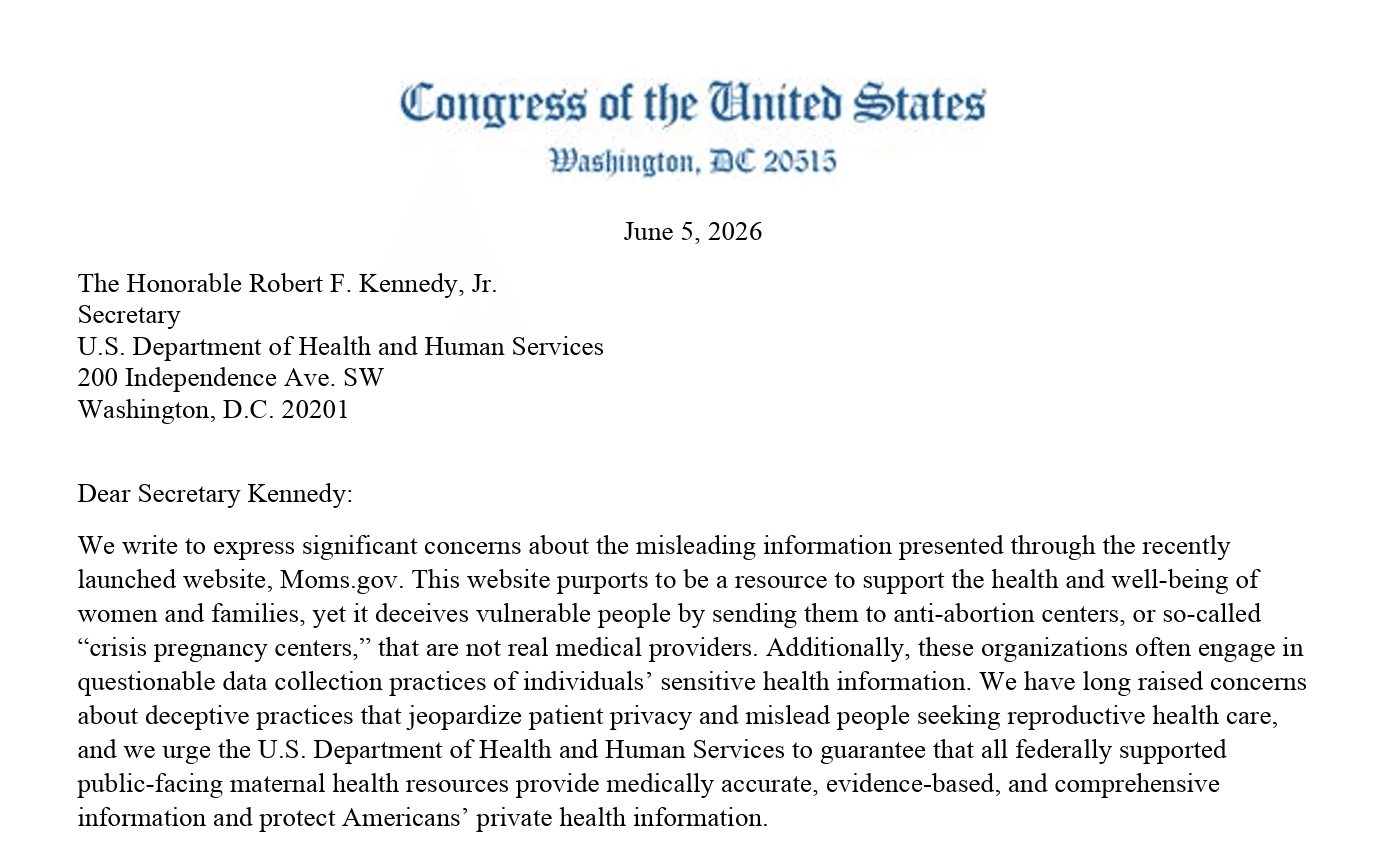
WASHINGTON, DC – In response to a congressional inquiry signed by 80+ U.S. House members seeking answers about the development, oversight, and promotion of Moms.gov, a new federal website “for new and expecting mothers,” Reproductive Health and Freedom Watch is calling on the U.S. Department of Health and Human Services to immediately suspend the website while lawmakers’ questions are investigated and resolved.
Pregnancy is inherently time-sensitive. Women facing serious complications—including severe bleeding, ectopic pregnancy, preeclampsia, miscarriage, reduced fetal movement, or conditions identified only through diagnostic testing—cannot afford confusion about where to seek care. Yet Moms.gov presents unregulated pregnancy clinics (UPCs) and federally qualified health centers (FQHCs) as comparable options, despite their vastly different capabilities. FQHCs are equipped to provide comprehensive care; UPCs typically are not. The result is a misleading equivalency that risks delaying access to appropriate medical treatment when every minute counts.
Even more concerning, despite many UPCs marketing their ultrasound services for the purpose of diagnosing ectopic pregnancy, reporting has documented UPC industry leaders directing staff not to provide ultrasound scans to women with suspected ectopic pregnancies, even though ectopic pregnancy is a medical emergency that can rapidly become life-threatening.
Currently, a pregnant woman confronting a serious complication who turns to Moms.gov as a trusted federal website may be routed to an organization incapable of treating her condition, and lose precious time before reaching appropriate medical care. When minutes and hours can determine whether a woman suffers permanent injury, loses a pregnancy, or faces a life-threatening emergency, the problem is not theoretical —it is a matter of patient safety.
“At some point, someone has to ask whether reproductive health politics are crowding out basic common sense,” said Debra Rosen, Executive Director of Reproductive Health and Freedom Watch. “Pregnant women do not need ideology when they are experiencing severe bleeding, signs of an ectopic pregnancy, preeclampsia, reduced fetal movement, or other potentially life-threatening complications. They need qualified healthcare professionals prepared to treat them, accurate medical information, and evidence-based care. The troubling message from Moms.gov is that a network of organizations with limited clinical capacity is somehow equivalent to a federally qualified health center for accessing the healthcare pregnant women need.”
RHFW welcomes the request by members of Congress for oversight of Moms.gov and the process by which the federal government chose to elevate unregulated pregnancy clinics as a component of its maternal health strategy.
The credibility of a federal .gov website carries enormous weight. Americans reasonably assume that resources promoted by the federal government have been vetted for their ability to provide appropriate care, protect patient privacy in compliance with HIPAA, and operate under meaningful standards of medical oversight. The questions raised by Congress call that assumption into question and deserve prompt answers.
Until Congress receives satisfactory answers regarding how organizations promoted on the website were selected, what standards were applied, whether listed organizations are equipped to respond appropriately to pregnancy-related complications, and what safeguards exist to protect women seeking care through the site, Moms.gov should be taken offline.